

TL;DR
- The downtime is in the diagnosis and the second trip, not in the fitting. A matched chamber-and-slack kit removes the two most common reasons a brake repair does not finish in one visit.
- Chamber and slack adjuster are a matched interface, not two separate parts. The push rod thread has to match the chamber stroke, and the lever geometry has to suit the chamber type.
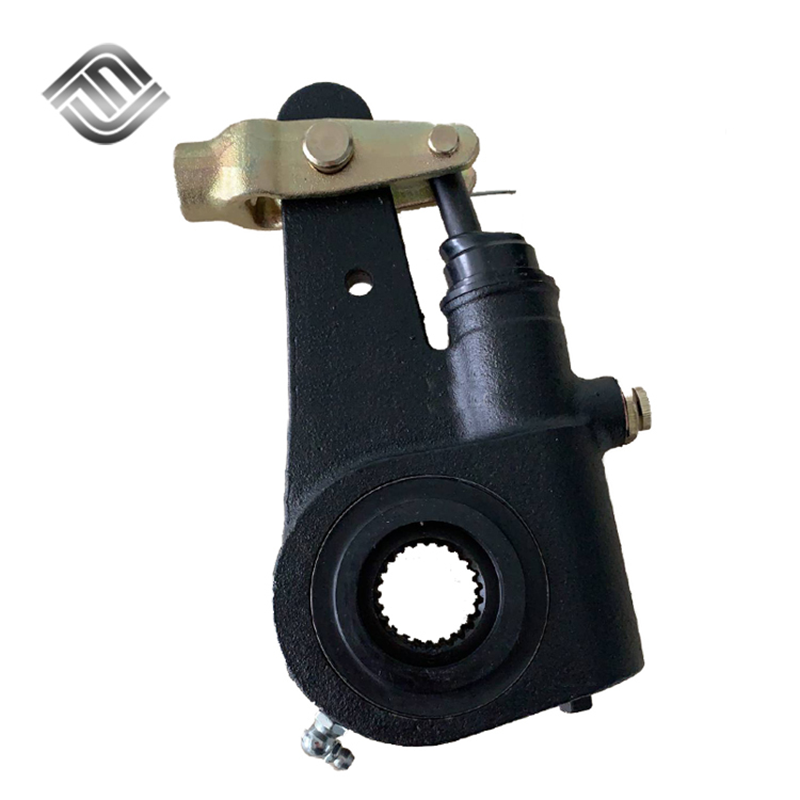
- A published example: the R801002 automatic slack adjuster specifies a 1-1/4″-24 spline, a 5-1/2″ lever, a 1/2″-20 push rod thread, and nine component parts.
- Validate the 30% figure against your own baseline. It is a commonly-quoted outcome for matched kits, not a published constant, and the reduction depends entirely on what your current failure pattern looks like.
When a truck comes off the road with a brake fault, the parts themselves are usually not the problem. The time is spent working out which of two or three related components actually failed, finding a compatible replacement, and then discovering at fitting that the second component should have been replaced at the same time.
A pre-matched chamber and slack adjuster kit removes the diagnosis step and the second-trip step together. That is the mechanism behind the downtime reductions repair chains report when they move to matched kits.
Shaoxing Fangjie Auto Accessory, founded in 2003, supplies both sides of that interface as separate product lines — the brake slack adjuster range and the brake chamber category — with the adjuster specified per vehicle application rather than as a generic part.
Where the Downtime Actually Goes
Before the matched-kit argument can be assessed, it helps to be specific about which part of a brake repair consumes the vehicle time. Four stages account for most of it, and only one of them is the actual fitting.
Stage one: diagnosis
A slack adjuster that stops adjusting is a symptom. The underlying question is whether the adjuster has seized, whether the chamber has lost its stroke, whether the cam or the camshaft wear is the real cause, or whether the chamber has simply reached end of service life. Distinguishing these requires the vehicle on a ramp, and that time is charged to the job whether or not a part is replaced.
Stage two: parts matching
This is where most of the avoidable delay sits. An adjuster is not interchangeable across the range. The R801002 automatic slack adjuster specified for Meritor 1-1/4″-24 is a different part from the R801001 in the 1-1/4″-10 spline and the R801074 in the 1-1/2″-28 spline. Ordering the wrong one is a delay measured in transit, not in diagnosis.
Stage three: the chamber question
An adjuster and its chamber form a matched pair. A replacement adjuster fitted to a worn chamber will under-perform, and in a repair-chain operation that produces a second visit later — which consumes more workshop time in total than replacing both while the vehicle is already on the ramp.
Stage four: the second trip
Once the vehicle has left, the cost is not over. The driver needs a replacement, the second visit needs another slot, and the fault may be recorded as unresolved until then. Repair chains measure this explicitly because it is the failure mode that makes a brake operation look more effective than it actually is.
What Pre-Matched Means at the Component Level
Matched does not mean the two parts come in one box. It means the specification of one constrains the other, so the correct pairing can be identified from the vehicle rather than inferred from what is on the shelf.
Spline and lever geometry define the adjuster
A representative specification shows how tightly these features define the part. The R801002 is listed with a 1-1/4″ spline at 24 teeth, a 5-1/2″ lever length, and a 1/2″-20 push rod thread. Each of those is a differentiator between otherwise similar-looking parts, and each one is the kind of detail that is missed when a replacement is ordered from a photograph rather than a part number.
Component count predicts serviceability
The same product is published as a nine-part assembly: big seal, worm wheel, sealing ring, ratchet, ratchet plastic, ratchet ring, ratchet pin, rod, and dust cover. That breakdown is not incidental. It tells you the adjuster is a serviceable assembly rather than a sealed unit, and it tells you which consumables are likely to be wanted again at the next service.
The chamber-side constraint
The adjuster specification carries the push rod thread because that is the interface to the chamber. Matching the rod thread alone is not sufficient — the chamber type determines the stroke and stroke direction the adjuster is designed to take up, which is why chamber and adjuster are specified together in the vehicle parts catalogue rather than independently.
About That 30% Figure: What It Depends On
A reduction of around 30% in brake downtime is a figure repair chains commonly quote when they move to pre-matched kits, and it is worth being precise about what it is and is not.
There are two ways it reads honestly, and they are not interchangeable.
Read as an absolute — “downtime falls by 30% regardless” — it is indefensible, because nothing about matched kits changes how long a diagnosis takes on a vehicle with an ambiguous fault. The reduction comes from removing specific steps, and those steps have to be present in your baseline for the reduction to exist.
Read as conditional — “downtime on matched repairs falls by around 30% against the same repairs done as unmatched” — it is a reasonable expectation with a clear mechanism behind it. The mechanism is measurable, which means you can test it rather than assume it.
What you can measure instead
If the 30% claim matters to your operation, measure the inputs rather than arguing about the output. Three measurements are enough:
- Average vehicle-immobilised time from fault report to roadworthy, recorded separately for matched and unmatched jobs
- Proportion of jobs completed in a single visit
- Number of repeat visits attributable to a second component found on inspection
If your single-visit completion rate is already high and repeat visits are rare, matched kits will show a smaller change than 30% because there is less avoidable time to remove. If a meaningful share of your jobs involve a second component discovered during the same repair, the effect will be larger. Both are knowable from your own records, and both take less time to establish than a supplier conversation.
Where Matched Kits Help Most, and Where They Do Not
Matched kits are a strong answer in specific situations and a weaker one in others. Being clear about the boundary is more useful than a general recommendation.
Strongest case: high-volume routine servicing
A fleet operation replacing chambers and adjusters on a schedule has high part volumes, predictable application data, and a stable failure pattern. This is where matched kits have the least friction, because the correct pairing is known in advance and inventory can be planned against it.
Strong case: multi-brand mixed fleets
Where a fleet runs Meritor, Bendix, Haldex, Crewson, Gunite, and Knorr applications together, cross-referencing from a single inventory becomes difficult. The adjuster range covers multiple application families, which is what makes a single supplier workable for that kind of fleet.
Weakest case: a single vehicle with an ambiguous fault
If the adjuster has not seized and the chamber is intact, replacing both is not a time saving — it is unnecessary part consumption. Matched kits address pairing, not diagnosis, and pairing is not the problem in that scenario.
Weakest case: very low volume
For a single-unit operator, holding pre-matched inventory across multiple applications carries more exposure than it saves. The ordering time saving is real but small, and the capital tied up in slow-moving part numbers is a poor trade.
How to Specify a Matched Kit Without Guesswork
Four questions determine whether a quoted kit is genuinely matched or merely bundled. They are worth asking before a purchase order is raised, because the answers are structural rather than commercial.
1. Is the chamber type named, not just its size?
Chamber size alone does not determine the interface. The type determines stroke and stroke direction, which is what the adjuster is matched to. A quote giving only a chamber size has not specified the pair.
2. Is the push rod thread stated on the adjuster?
This is the single most useful number to have in front of you when matching. If the adjuster specification does not state a push rod thread, the pairing has not been defined.
3. Is spline size and tooth count stated?
Both, not either. The adjuster range includes 1-1/4″ at 10 teeth and 1-1/4″ at 24 teeth as separate parts, and 1-1/2″ at 28 teeth as another. Spline diameter without tooth count is not a complete designation.
4. Is the component list published?
A published assembly breakdown tells you the product is serviceable and tells you what the next service will need. It also tells you whether you are buying an assembly or a sealed unit.
| Field | Example value | Why it matters for matching |
|---|---|---|
| OEM number | R801002 | Identifies the exact part rather than a type |
| Spline diameter and teeth | 1-1/4″ × 24 | Differentiates from the 1-1/4″ × 10 variant |
| Lever length | 5-1/2″ | Determines lever geometry on the chamber |
| Push rod thread | 1/2″-20 | The physical interface to the chamber |
| Component count | 9 parts | Indicates a serviceable assembly |
| Adjustment type | Automatic | Determines servicing routine and wear parts |
| Chamber type and size | Required from the vehicle | Sets stroke the adjuster is matched to |
Frequently Asked Questions
How much brake downtime do pre-matched kits actually save?
A reduction of around 30% is a commonly-quoted outcome for matched kits, but it is not a published constant and it depends entirely on the baseline. Measure average immobilised time, single-visit completion rate, and repeat visits attributable to a second component in your own operation before committing to the figure.
What makes a chamber and slack adjuster a matched pair?
They form a mechanical interface rather than two independent parts. The adjuster push rod thread has to match the chamber connection, and the adjuster design has to suit the chamber stroke and stroke direction. Matching on a size alone does not define the pair.
Are all automatic slack adjusters interchangeable?
No. The published range includes separate parts for different spline and thread combinations, such as 1-1/4″ at 10 teeth, 1-1/4″ at 24 teeth, and 1-1/2″ at 28 teeth. Spline diameter alone is not a complete designation because tooth count and lever length also differ between parts that look similar.
What is the R801002 slack adjuster used on?
It is specified for Meritor applications with a 1-1/4″ spline at 24 teeth, a 5-1/2″ lever, and a 1/2″-20 push rod thread. It is published as a nine-part assembly comprising big seal, worm wheel, sealing ring, ratchet, ratchet plastic, ratchet ring, ratchet pin, rod, and dust cover.
Does an automatic slack adjuster need servicing?
Yes, and the published component list makes that visible. Because the R801002 is specified as nine parts including seals and ratchet components, consumables can be replaced individually at service rather than replacing the whole assembly.
When are matched kits not worth using?
On a single vehicle with an ambiguous fault where neither component has actually failed, and at very low operating volume where holding pre-matched inventory across multiple applications ties up capital in slow-moving part numbers for a small ordering-time saving.
How should I order an automatic slack adjuster for a mixed fleet?
By application rather than by size. Identify the OEM number and the spline, tooth count, lever length, and push rod thread for each application in your fleet, then group orders by those fields. A supplier covering multiple application families can then supply against a consistent specification set.
What questions confirm a kit is genuinely matched?
Ask whether the chamber type and size are named rather than just the size, whether the adjuster push rod thread is stated, whether spline diameter and tooth count are both given, and whether the component list is published. Answers covering all four indicate the pairing has been defined.
Which Approach Should You Take?
Adopt pre-matched kits where you have high volume, a multi-brand fleet, or a visible repeat-visit problem. Those are the conditions under which removing the matching and second-visit steps actually removes measurable time.
Measure before claiming. Track immobilised time and single-visit completion for matched and unmatched jobs separately for long enough to see a difference, and let that measurement rather than a supplier figure set your expectation.
Keep the specification discipline regardless of which model you use. An OEM number, spline and tooth count, lever length, and push rod thread on every order removes the most common cause of delay, whether or not the parts arrive pre-matched.
Elian Zhou
Export Manager, Shaoxing Fangjie Auto Accessory Co., Ltd.
I have more than twenty years of OEM production experience in truck brake system components since 2003, based in Shaoxing, Zhejiang. I work daily with a workforce of over a hundred and a ten-person foreign trade team supplying brake calipers, slack adjusters, solenoid valves, and brake chambers to aftermarket distributors across Europe, Southeast Asia, and the Middle East.
I am on the factory floor regularly and share production process insights — from automatic slack adjuster assembly to CNC machining of caliper housings — on my YouTube channel. The point I would emphasise for anyone ordering these parts is that the naming detail on an adjuster is the specification, not an afterthought.
Post time: Oct-22-2026