

The braking system of a heavy-duty commercial vehicle is the most critical safety component for operational security. At the heart of this system lies the brake caliper, a hydraulic or air-actuated component responsible for clamping brake pads against the rotor to create friction. For fleet managers and owner-operators, maintaining semi-truck brake calipers is not merely a mechanical necessity but a regulatory requirement under Department of Transportation (DOT) standards. This guide provides a technical overview of caliper inspection, lubrication protocols, and failure analysis to ensure maximum vehicle uptime and road safety.
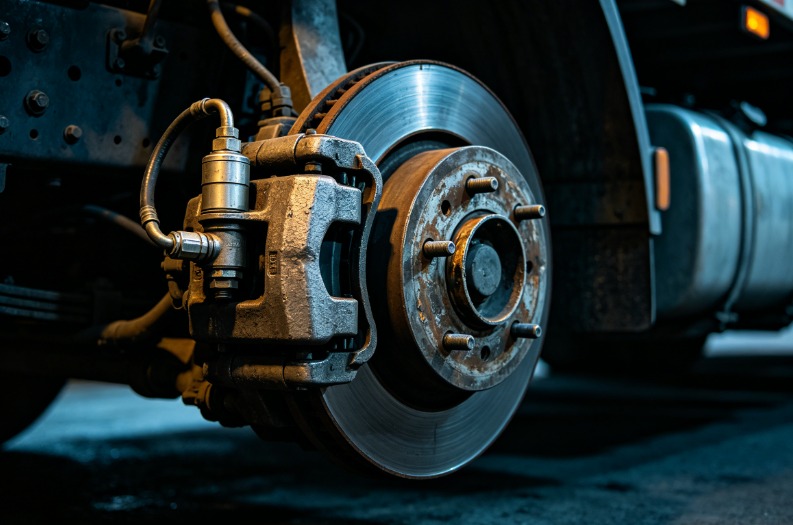
Understanding the Mechanics of Heavy-Duty Air Disc Brake Calipers
Commercial semi-trucks predominantly utilize Air Disc Brakes (ADB) for superior heat dissipation and reduced brake fade compared to traditional drum brakes. An air disc brake caliper functions by converting compressed air pressure into mechanical force via an internal power screw and bridge mechanism. According to technical documentation from the Federal Motor Carrier Safety Administration (FMCSA), brake-related violations consistently rank among the top reasons for commercial vehicles being placed Out-of-Service (OOS) during roadside inspections. Proper maintenance ensures the caliper slide pins and pistons move freely, preventing uneven pad wear and thermal damage to the wheel end components.
Essential Inspection Intervals and Regulatory Compliance
Standard maintenance cycles for semi-truck brake calipers should align with the Preventative Maintenance (PM) intervals of the vehicle, typically every 25,000 to 50,000 miles depending on duty cycle. Severe-duty applications, such as construction or refuse hauling, require monthly inspections. Inspectors must verify the integrity of the guide pin boots and the piston bellows. Tears in these rubber components allow moisture and road salts to enter the internal housing, leading to corrosion and “seized” calipers. Data from the Commercial Vehicle Safety Alliance (CVSA) indicates that nearly 25% of all vehicle out-of-service violations are attributed to brake system defects.
Critical Components of Semi Truck Brake Caliper Systems
A professional inspection focuses on three primary sub-assemblies within the caliper housing. The following table outlines the critical components and their specific maintenance requirements:
| Component | Function | Maintenance Requirement |
|---|---|---|
| Guide Pins | Allow the caliper to slide laterally for even pressure. | Inspect for corrosion; apply high-temp silicone grease. |
| Piston Bellows | Protect the hydraulic or air pistons from debris. | Check for cracks, heat hardening, or punctures. |
| Mounting Bolts | Secure the caliper bracket to the steering knuckle. | Verify torque specifications (typically 350-400 lb-ft). |
Troubleshooting Common Caliper Failure Modes
Identifying early signs of caliper failure prevents catastrophic brake loss and expensive rotor replacements. The most frequent indicator of a malfunctioning caliper is lateral pulling during braking or excessive heat radiating from a specific wheel end. If one brake pad shows significantly more wear than the opposing pad on the same rotor, the caliper guide pins are likely seized. This condition prevents the caliper from “floating,” causing one pad to remain in constant contact with the rotor. For replacement parts that meet rigorous safety standards, operators can source heavy-duty truck brake components designed for high-stress environments.
Proper Lubrication Procedures for Slide Pins and Brackets
Lubrication is the most vital preventive measure for sliding-style calipers. Technicians must use specialized high-temperature, synthetic lubricants that are compatible with EPDM rubber boots. Petroleum-based greases should never be used, as they cause rubber components to swell and degrade. Applying lubricant to the contact points between the brake pad tabs and the caliper bracket prevents “binding.” Ensuring smooth movement reduces the risk of “dragging brakes,” which can increase fuel consumption by 1% to 3% due to parasitic drag. Quality reflective safety equipment should also be inspected during wheel-end service to maintain vehicle visibility during roadside repairs.
Impact of Caliper Health on Commercial Vehicle Stopping Distance
The efficiency of a semi-truck’s braking distance is directly proportional to the mechanical health of the calipers. Research published by the National Highway Traffic Safety Administration (NHTSA) demonstrates that a fully loaded semi-truck traveling at 65 mph requires approximately 525 feet to stop under ideal conditions. Seized or sluggish calipers increase this distance by delaying the application of clamping force. Furthermore, uneven braking forces across different axles can lead to jackknifing or loss of directional control during emergency maneuvers. Regular maintenance of the braking system hardware is a fundamental aspect of proactive fleet risk management.
Diagnostic Hardware and Measurement Specifications
Precision measurement is required to determine if a caliper is within the manufacturer’s operational tolerances. Technicians utilize dial indicators to measure “running clearance,” which is the small gap between the pad and rotor when the brakes are released. For most heavy-duty ADB systems, the ideal clearance is between 0.6 mm and 1.2 mm. If the clearance exceeds these specifications, the internal automatic adjuster mechanism within the caliper may be failing. Monitoring these technical specifications ensures that the vehicle adheres to the Brake Safety Research guidelines provided by the American Trucking Associations (ATA).
Recommended Maintenance Tools for Heavy-Duty Brake Service
| Tool Type | Specific Use Case | Importance |
|---|---|---|
| Caliper Press | Retracting pistons without damaging seals. | High |
| Torque Wrench | Ensuring mounting bolts meet OEM specs. | Critical |
| Dial Indicator | Measuring rotor runout and caliper drag. | Medium |
| Borescope | Inspecting internal adjuster gears. | Optional |
Environmental Factors Affecting Caliper Longevity
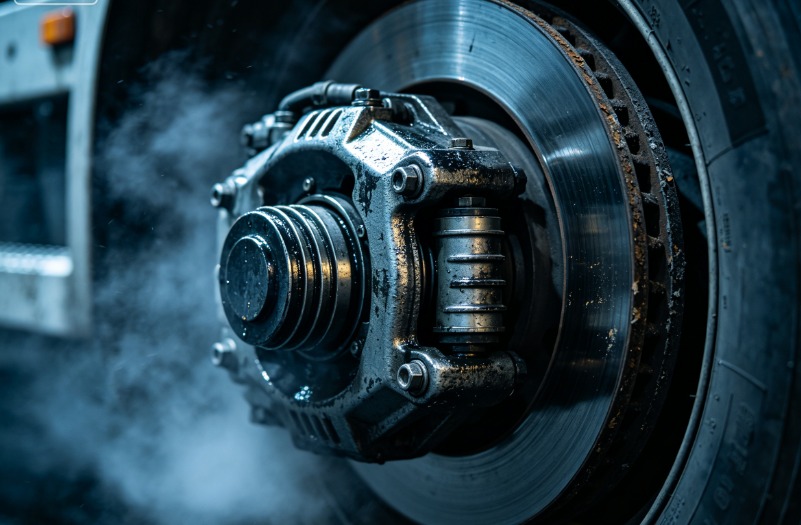
Environmental conditions, specifically the use of liquid de-icing agents like magnesium chloride on winter roads, significantly accelerate caliper corrosion. These chemicals are highly hygroscopic and can penetrate even microscopic cracks in protective coatings. Fleet operators in northern climates should implement a “pressure wash” protocol to remove chemical residues from the wheel ends after every trip. Using corrosion-resistant commercial vehicle parts and ensuring all dust caps are securely in place are effective strategies for extending the service life of calipers in harsh environments.
Replacement vs. Rebuild: Economic Considerations
Fleet managers must decide between purchasing new calipers or utilizing remanufactured units when a failure occurs. While remanufactured calipers offer a lower initial price point, they must be sourced from facilities that adhere to ISO 9001 quality standards to ensure reliability. A “seized” caliper usually indicates internal gear failure, which often makes a field rebuild impractical. Statistics from the Bureau of Transportation Statistics (BTS) suggest that preventative maintenance costs are significantly lower than the combined costs of emergency roadside assistance and potential legal liabilities resulting from brake-related accidents.
Final Summary of Maintenance Best Practices
The integrity of semi-truck brake calipers is sustained through a combination of frequent visual inspections, precise lubrication, and adherence to torque specifications. Key conclusions for effective maintenance include:
- Verify guide pin mobility at every pad change to prevent dragging.
- Replace all rubber boots and seals if any signs of heat hardening or tearing appear.
- Use only synthetic, non-petroleum lubricants on all sliding surfaces.
- Monitor pad wear patterns as a primary diagnostic tool for caliper health.
Implementing these protocols ensures that commercial truck safety standards are consistently met, protecting both the driver and the public.
Frequently Asked Questions (FAQ)
How can a technician determine if a semi-truck brake caliper is seized without removing the wheel?
A technician can identify a seized caliper by checking the temperature of the wheel hub using an infrared thermometer after a short drive. A temperature variance of more than 50°F (10°C) between wheels on the same axle typically indicates a dragging caliper that has failed to retract.
What is the specific torque requirement for heavy-duty caliper mounting bolts?
While specifications vary by manufacturer (such as Bendix or Meritor), most semi-truck caliper mounting bolts require a torque between 350 and 400 lb-ft. It is critical to use a calibrated torque wrench, as under-tightening leads to vibration and over-tightening can cause bolt fatigue or thread stripping.
Why is it prohibited to use standard chassis grease on caliper slide pins?
Standard chassis grease is often petroleum-based, which causes the EPDM rubber boots used in brake systems to swell, soften, and eventually tear. Once the boot fails, moisture enters the slide pin cavity, causing rapid oxidation and seizing. Only high-temperature silicone or polyalkylene glycol (PAG) greases should be applied.
What is the difference between a floating caliper and a fixed caliper in heavy trucks?
A floating caliper moves laterally on guide pins to apply pressure to both sides of the rotor using pistons on only one side. A fixed caliper is bolted rigidly to the bracket and uses pistons on both sides of the rotor. Most semi-trucks use floating calipers to simplify maintenance and reduce weight.
When should a brake caliper be replaced instead of just replacing the pads?
A caliper requires replacement if there is evidence of hydraulic fluid leakage from the piston seals, if the internal adjuster mechanism fails to maintain proper pad-to-rotor clearance, or if the sliding surfaces are so heavily pitted by corrosion that they impede smooth movement.
Post time: May-07-2026