

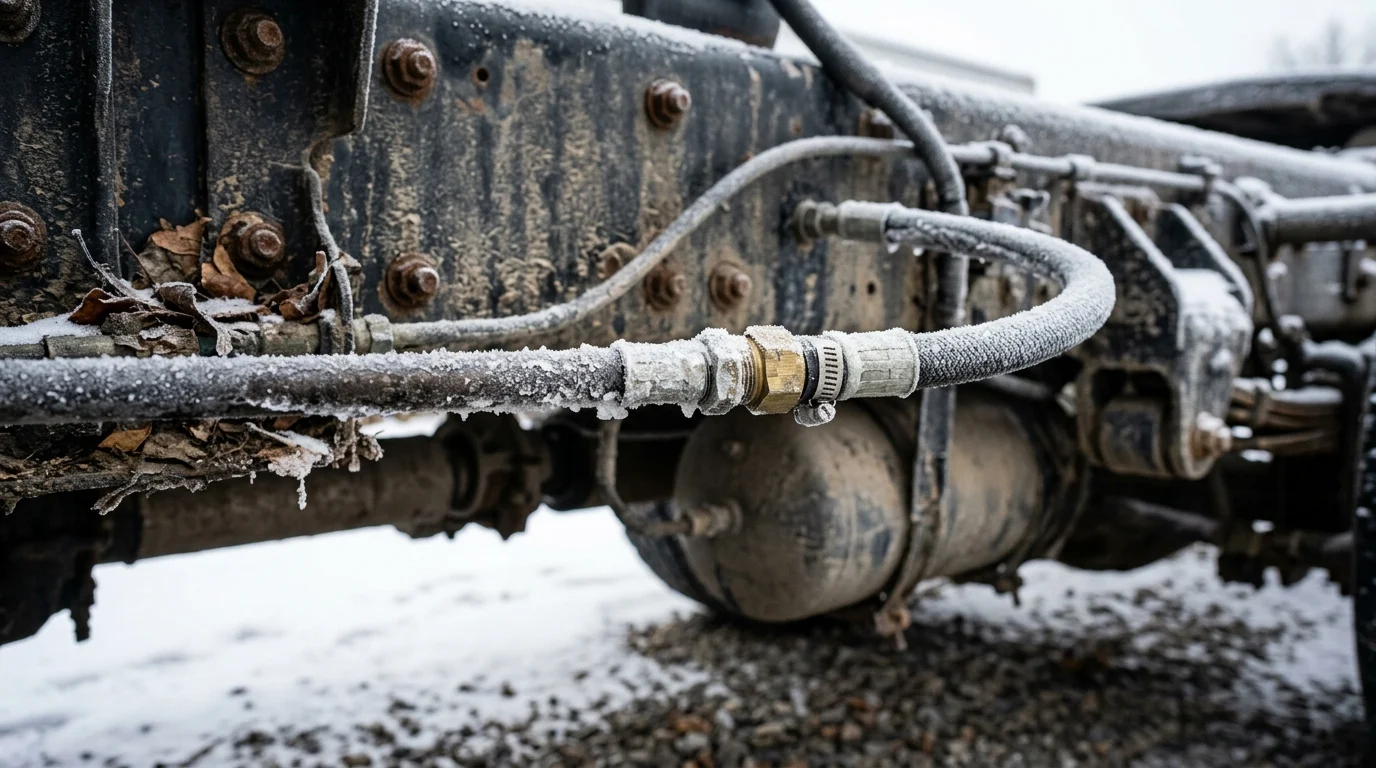
Truck Brake Line Freezing: Risk and Scope
Operating heavy-duty commercial vehicles in sub-zero environments introduces severe mechanical vulnerabilities. Truck brake line freezing stands as one of the most critical threats to fleet safety and logistics timelines. When ambient temperatures plummet below 32°F (0°C), the pneumatic systems actuating commercial air brakes become highly susceptible to ice blockages. The risk extends from minor operational delays to catastrophic brake failures, requiring fleet managers and maintenance directors to implement rigorous winterization protocols.
Operational impact on fleet uptime
Frozen brake lines directly translate to severe disruptions in fleet uptime and route scheduling. When a truck is immobilized by locked or unresponsive brakes, immediate financial consequences include emergency roadside service (ERS) call-outs, which typically range from $500 to $1,200 depending on the severity of the freeze and the vehicle’s location.
Furthermore, immobilized assets generate indirect costs through missed delivery windows, spoiled temperature-controlled freight, and compromised customer service level agreements (SLAs). Industry estimates indicate that an unexpected mid-route breakdown can cost a fleet upwards of $800 to $1,500 per day in lost revenue alone, not accounting for cascading delays that affect subsequent dispatch cycles.
What frozen truck brake lines mean
At a mechanical level, frozen truck brake lines mean the pneumatic signals required to apply or release the brake shoes cannot travel between the reservoirs, valves, and brake chambers. Commercial air brake systems operate by utilizing pressurized air to overcome the mechanical force of heavy-duty springs.
If ice forms within the primary or secondary air lines, relay valves, or gladhands, it creates an impermeable pneumatic blockage. Consequently, the system may fail to transmit the air pressure necessary to release the parking brakes—leaving the trailer immobilized—or, more dangerously, fail to deliver the application pressure required to engage the service brakes during transit.
When freezing becomes a safety issue
The transition from a mechanical nuisance to a critical safety issue occurs when ice formation partially restricts air flow, leading to delayed brake application or uneven braking force across the axles. This asymmetry drastically increases stopping distances and elevates the probability of jackknifing on slick winter roads.
Under Federal Motor Carrier Safety Administration (FMCSA) regulations, compromised braking systems are a primary trigger for Out-of-Service (OOS) violations. Historical data from Commercial Vehicle Safety Alliance (CVSA) International Roadcheck events consistently shows that brake system defects account for nearly 29% of all vehicle OOS violations. A frozen line that prevents a single brake chamber from actuating renders the entire combination vehicle fundamentally unsafe and legally unfit for operation.
Technical Causes of Brake Line Freezing
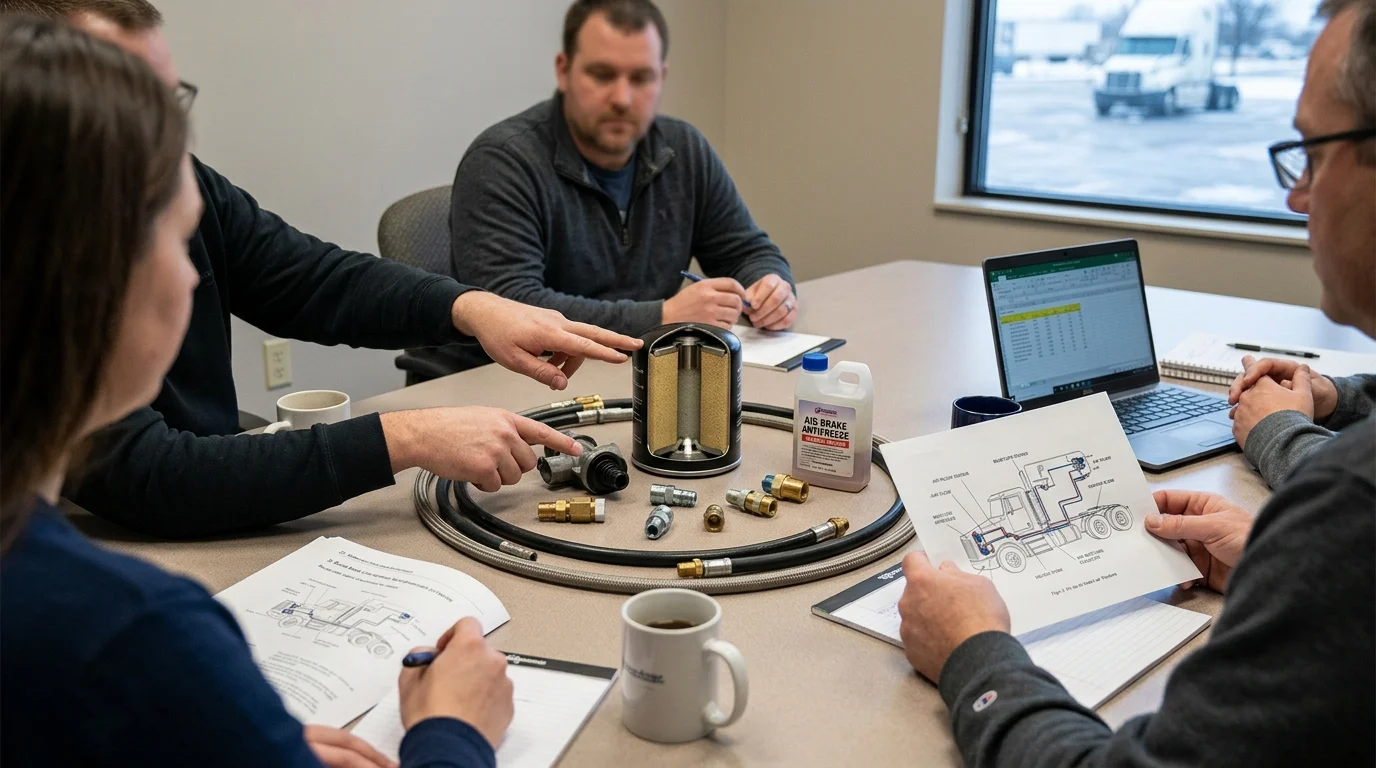
Understanding the technical causes of truck brake line freezing requires examining pneumatic thermodynamics and the inherent vulnerabilities of compressed air systems. The root cause of all freezing events is the presence of liquid water within the air brake infrastructure, which undergoes a phase change when exposed to freezing ambient temperatures.
Moisture in compressed air systems
Moisture continuously enters compressed air systems because ambient air inherently contains water vapor. When the vehicle’s air compressor draws in atmospheric air and compresses it to operating pressures—typically between 100 and 125 PSI—the concentration of water vapor per unit of volume increases dramatically.
During high-humidity conditions, a standard heavy-duty compressor can ingest up to 2 fluid ounces of water per operational shift. If the vehicle’s air dryer is malfunctioning, overwhelmed, or operating with saturated desiccant material, this moisture bypasses the initial filtration stage and is pumped directly into the supply reservoir, commonly known as the wet tank.
Temperature drops and condensation
The physics of temperature drops and condensation governs the transition of water vapor into hazardous liquid water. As highly pressurized, heated air exits the compressor, it travels through the discharge line and begins to cool. The temperature at which this air can no longer hold all its water vapor is known as the dew point.
Once the compressed air cools below its dew point within the reservoirs or distribution lines, the vapor condenses into liquid droplets. When the external ambient temperature drops below the freezing threshold of 32°F (0°C), this accumulated condensation rapidly crystallizes into ice, forming rigid blockages within narrow pneumatic pathways.
High-risk components and failure points
Certain segments of the air brake architecture are disproportionately vulnerable to ice accumulation due to their physical placement, orifice sizes, and exposure to wind chill. Identifying these high-risk components is essential for targeted winter diagnostics.
| Component | Failure Mode | Vulnerability Level |
|---|---|---|
| Air Dryer Purge Valve | Ice prevents the valve from expelling moisture, causing water to back up into the system. | Critical |
| Gladhands | Snow and ice ingress during uncoupled periods; moisture freezes at the tractor-trailer connection. | High |
| Relay Valves | Condensation pools in the valve housing, freezing the internal diaphragm and blocking air delivery. | High |
| ABS Solenoids | Micro-orifices become blocked by minute ice crystals, disabling anti-lock functionality. | Moderate |
Winter Preventive Maintenance Steps
Mitigating the risks of pneumatic freezing requires a proactive, comprehensive winter preventive maintenance strategy. Fleet maintenance departments operating in cold climates must shift from reactive repairs to predictive servicing, typically initiating winterization protocols in early autumn to ensure peak system integrity before the first freeze.
Pre-winter air brake inspection
A rigorous pre-winter air brake inspection serves as the foundational step in cold-weather preparation. Technicians must systematically evaluate the entire pneumatic circuit, beginning with the compressor discharge line. Carbon buildup inside the discharge line restricts air flow, forcing the compressor to run hotter and longer. This inadvertently increases the volume of moisture passed into the system.
The inspection must also verify the functionality of automatic drain valves on the air reservoirs. Manual draining of the wet tank should be performed daily to observe the effluent; the presence of excessive water or an oil-water emulsion strongly indicates upstream failures that require immediate remediation.
Air dryer and moisture control practices
Air dryer and moisture control practices are the primary defense mechanisms against brake line freezing. The air dryer utilizes a desiccant cartridge to adsorb water vapor before it reaches the reservoirs. Standard industry practice dictates replacing this cartridge every one to two years, or roughly every 100,000 miles, depending on vocational demands.
Furthermore, technicians must test the air dryer’s internal heater element. This thermostatically controlled heater typically activates when temperatures fall to 45°F (7°C) and draws between 3 to 5 amps of electrical current. If the heater element fails, the purge valve will freeze shut, trapping accumulated moisture inside the dryer housing.
When to replace marginal components
Determining when to replace marginal components relies on strict performance metrics rather than simple visual inspections. If compressor oil blow-by exceeds 10% to 15% of the normal air volume, the aerosolized oil will coat the desiccant beads, permanently destroying their moisture-absorbing porosity.
In such cases, replacing the desiccant without addressing the compressor oil blow-by is futile. Additionally, air dryers and inline valves exhibiting pressure drops greater than 2 to 4 PSI during standard operation should be flagged for replacement. These pressure differentials often indicate internal restrictions or failing seals that will exacerbate condensation pooling during extreme cold.
Products, Procedures, and Compliance
When preventive measures fail or extreme weather events overwhelm standard equipment, fleets must navigate a complex landscape of emergency interventions, chemical de-icers, and strict regulatory compliance. Employing incorrect thawing procedures can inflict irreversible damage on pneumatic components and expose the fleet to significant legal liabilities.
Approved de-icing and anti-freeze practices
Approved de-icing and anti-freeze practices require extreme caution and strict adherence to manufacturer guidelines. In emergency situations where lines are definitively frozen, the application of external heat via a heat gun or forced-air heater is the safest thawing method.
When chemical intervention is unavoidable, technicians may use a specialized air brake antifreeze, which is typically methanol-based. However, this must be applied sparingly. Injecting a maximum of 1 to 2 ounces of air brake alcohol directly into the gladhand or supply line is generally sufficient to melt localized ice blocks. Pouring large volumes of alcohol into the system is strictly prohibited by major component manufacturers.
Warranty and regulatory considerations
Warranty and regulatory considerations heavily dictate the permissible use of chemical de-icers. Leading brake system manufacturers explicitly warn that excessive alcohol exposure degrades internal rubber O-rings, valve seals, and synthetic lubricants. Routine use of methanol-based anti-freeze will void the warranties on expensive ABS modulators and air dryers.
From a regulatory standpoint, fleets must maintain compliance with FMCSA Part 393.41, which mandates operational parking brakes, and Part 393.50, requiring reservoirs to have sufficient capacity to ensure full brake application. Modifying the system with unapproved automatic alcohol evaporators can trigger compliance audits and OOS citations.
Adjustments by region, fleet age, and duty cycle
Maintenance strategies must incorporate adjustments by region, fleet age, and duty cycle to optimize resource allocation. A uniform approach is inefficient; a linehaul tractor operating continuously across the Canadian Shield requires a vastly different winterization profile than a vocational dump truck in the mid-Atlantic.
| Duty Cycle | Desiccant Change Interval | Winter Prep Strategy |
|---|---|---|
| Linehaul / Over-the-Road | 100,000 miles / 1 Year | Standard OEM cartridge replacement; verify heater element amperage. |
| Vocational / Refuse | 50,000 miles / 6 Months | Coalescing cartridges required due to high compressor duty cycles. |
| City Delivery / P&D | 75,000 miles / 1 Year | Daily manual tank drains; frequent gladhand seal inspections. |
Fleet Decision Framework
Establishing a robust fleet decision framework enables maintenance directors to systematically manage the threat of cold-weather pneumatic failures. By quantifying risks and standardizing operational protocols, fleets can protect their assets, optimize maintenance budgets, and ensure uncompromising safety during the harshest winter months.
Prioritizing preventive actions
Prioritizing preventive actions requires evaluating the return on investment for various maintenance tasks. Low-cost, high-impact actions, such as mandating daily manual tank drains, require zero capital expenditure but significantly reduce the moisture load on the system.
Conversely, proactively replacing desiccant cartridges represents a direct cost of $50 to $100 per vehicle, plus labor. However, when juxtaposed against the $800 minimum cost of a single winter ERS call for a frozen brake line—excluding the costs of delayed freight—the financial justification for comprehensive autumn preventive maintenance becomes irrefutable.
Balancing cost, risk, and downtime
Balancing cost, risk, and downtime is the core challenge for fleet operations managers. Consider a mid-sized fleet of 50 trucks operating in a northern climate. If deferred maintenance leads to a 10% freeze-up rate during a severe polar vortex, the fleet faces the immediate loss of five operational days.
At a conservative estimate of $1,000 in lost revenue per truck per day, alongside $4,000 in combined towing and emergency repair invoices, the financial penalty for that single weather event reaches $9,000. Investing $3,500 in fleet-wide desiccant upgrades and heater element testing eliminates the vast majority of this operational risk, yielding a strong positive net variance.
Final cold-weather operating guidance
The final cold-weather operating guidance must translate technical preventive measures into actionable daily routines for drivers and technicians. Fleets should mandate specialized winter pre-trip inspections that include observing the air compressor build time, which should reach 85 to 100 PSI within 45 seconds at standard RPM.
Personnel must physically inspect gladhand seals for cracks or ice buildup before coupling. Drivers must be trained to recognize the early warning signs of sluggish brake response and be explicitly prohibited from bypassing air dryers or pouring unauthorized chemicals into the lines. By enforcing these strict, data-driven protocols, fleets can maintain continuous, safe operations regardless of plummeting ambient temperatures.
Key Takeaways
- Drain air reservoirs regularly in freezing weather to remove liquid water before it can turn into ice inside the brake system.
- Service the air dryer, desiccant cartridge, purge valve, and heater before winter because moisture control is the primary defense against brake line freezing.
- Inspect gladhands, hoses, valves, and brake chambers for leaks or damaged seals that allow moisture entry and reduce reliable air pressure delivery.
- Do not operate a truck with delayed brake response, uneven braking, or frozen parking brakes because these conditions can create out-of-service violations and serious safety risks.
- Build winter brake inspections into fleet preventive maintenance schedules to reduce roadside service costs, missed deliveries, and unplanned downtime.
Frequently Asked Questions
Why do truck brake lines freeze in winter?
Truck brake lines freeze when moisture inside the compressed air system turns to ice below 32°F (0°C). Ice can block air lines, gladhands, relay valves, or brake chambers, preventing normal brake application or release.
How can drivers reduce brake line freezing before a trip?
Drivers should drain air tanks, verify the air dryer works, inspect lines and fittings for leaks, check gladhand seals, and confirm air pressure builds normally before departure. Any slow pressure build or delayed brake response needs maintenance attention.
Can a frozen brake line put a truck out of service?
Yes. If freezing causes delayed braking, uneven brake force, or failure to release parking brakes, the vehicle may be unsafe and legally unfit to operate. Brake system defects are a major cause of commercial vehicle out-of-service violations.
What parts are most affected by ice in an air brake system?
Ice commonly affects air lines, reservoirs, relay valves, gladhands, brake chambers, and valves exposed to moisture and cold airflow. Components from suppliers such as CNFJ Auto Parts should be inspected as part of winter brake maintenance.
Should alcohol or antifreeze be added to air brake lines?
Use only products approved by the vehicle or brake system manufacturer. Improper chemicals can damage seals, valves, and brake chambers. The safest prevention is a properly serviced air dryer, routine tank draining, and leak-free system components.
Post time: Jun-20-2026